
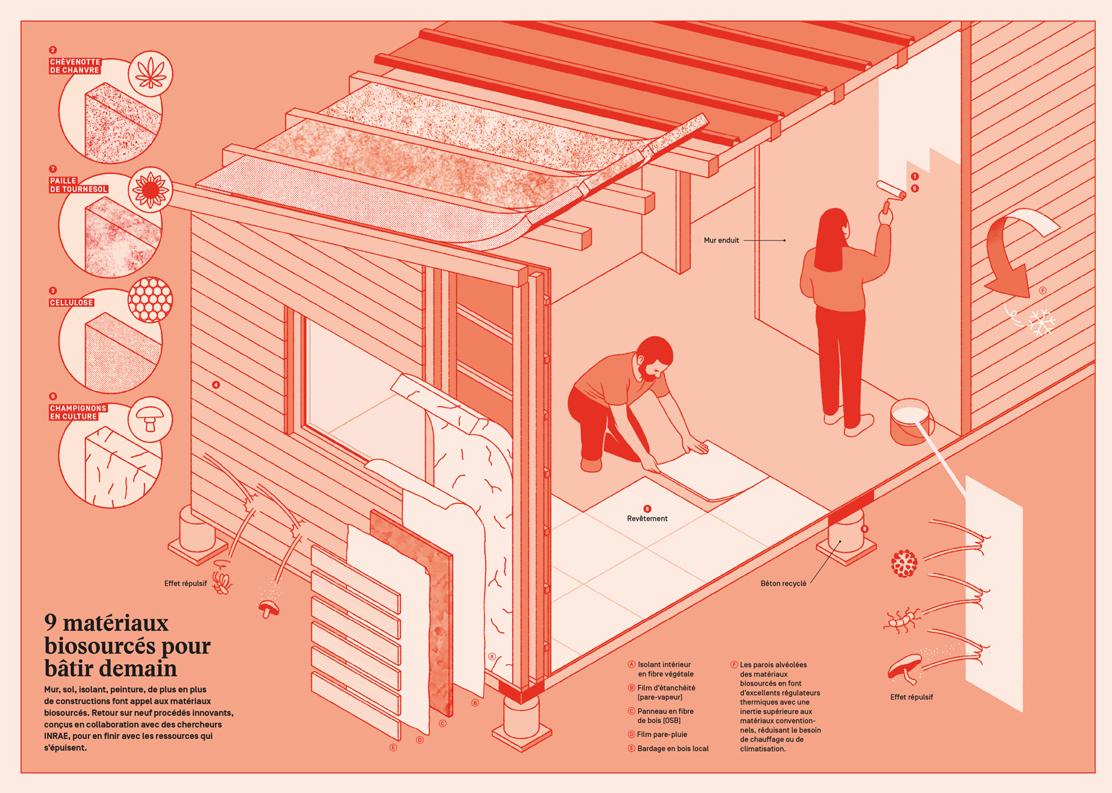
What if the future of construction no longer relied mainly on concrete, steel or materials of fossil origin, but on... living matter? Wood, hemp, straw, recycled fibres, bamboo: for a long time seen as alternatives, bio-based materials are now emerging as a concrete, effective and industrialisable response to the sector's climate challenges.
At a time when the construction sector must drastically reduce its carbon footprint whilst remaining economically competitive, these materials are fundamentally changing the game. On a global scale, they are redefining value chains, construction practices and business models.
Sustainable... and strategic materials
Biobased materials are derived from renewable biological resources. Their main advantage? They naturally capture carbon during their growth and store it sustainably in the building. Where conventional materials emit massive amounts of CO₂ as soon as they are manufactured, wood, hemp or straw can have a very low, or even negative, carbon footprint.
The potential of biobased materials is now fully recognised by regulations. In France, the RE2020 is no longer limited to the energy efficiency of buildings: it requires a complete analysis of the life cycle of materials, from their production to their end-of-life. Internationally, the trend is the same: the decarbonisation of materials is becoming a key lever in the sector's transition.
What was once a marginal innovation is now technically mastered, certified and integrated into increasingly structured industrial sectors.
Why is this transformation important for the construction sector?
Against a backdrop of strong environmental, regulatory and economic pressure, bio-based materials are opening up strategic prospects for the entire industry:
1. A major lever for reducing carbon emissions
Biosourced materials make it possible to significantly reduce the carbon incorporated into buildings.
- This is central to achieving the sector's climate objectives.
2. Technical performance that is now widely recognised
Structure, insulation, finishing: today, biobased materials cover the majority of construction needs.
- A credible alternative to conventional materials.
3. A tangible improvement in comfort and health
The use of bio-based materials helps to ensure more effective humidity control, greater thermal comfort in summer, better indoor air quality and improved acoustic performance.
- Direct benefits for occupants.
4. Rapid structuring of economic sectors
Agriculture, processing, logistics, recycling: new economic balances are emerging at regional level and in international trade.
- New markets and economic opportunities.
Is now the right time to take an interest?
All the indicators are converging: carbon regulations are becoming increasingly stringent, while demand for healthier, more sustainable buildings is growing. At the same time, bio-sourced products are gaining technical and insurance recognition, enabling the associated industries to grow rapidly.
Integrating bio-sourced materials into construction projects
- To take full advantage of these materials, a number of conditions need to be met:
- Setting carbon targets right from the design stage
- Choose materials with reliable environmental declarations
- Take into account their specific hygrothermal properties
- To ensure coordination between architects, design consultancies and contractors
- Anticipating supply and implementation issues
- This global approach allows us to optimise the environmental, technical and economic performance of our projects.
A weak signal... which isn't weak any more
Long regarded as niche options, bio-based materials are now establishing themselves as one of the cornerstones of low-carbon construction worldwide. They reflect a fundamental shift in the sector: the construction industry is moving towards a holistic approach to performance, in which the environment, health, the economy and quality of use are closely interlinked.
 French
 English