
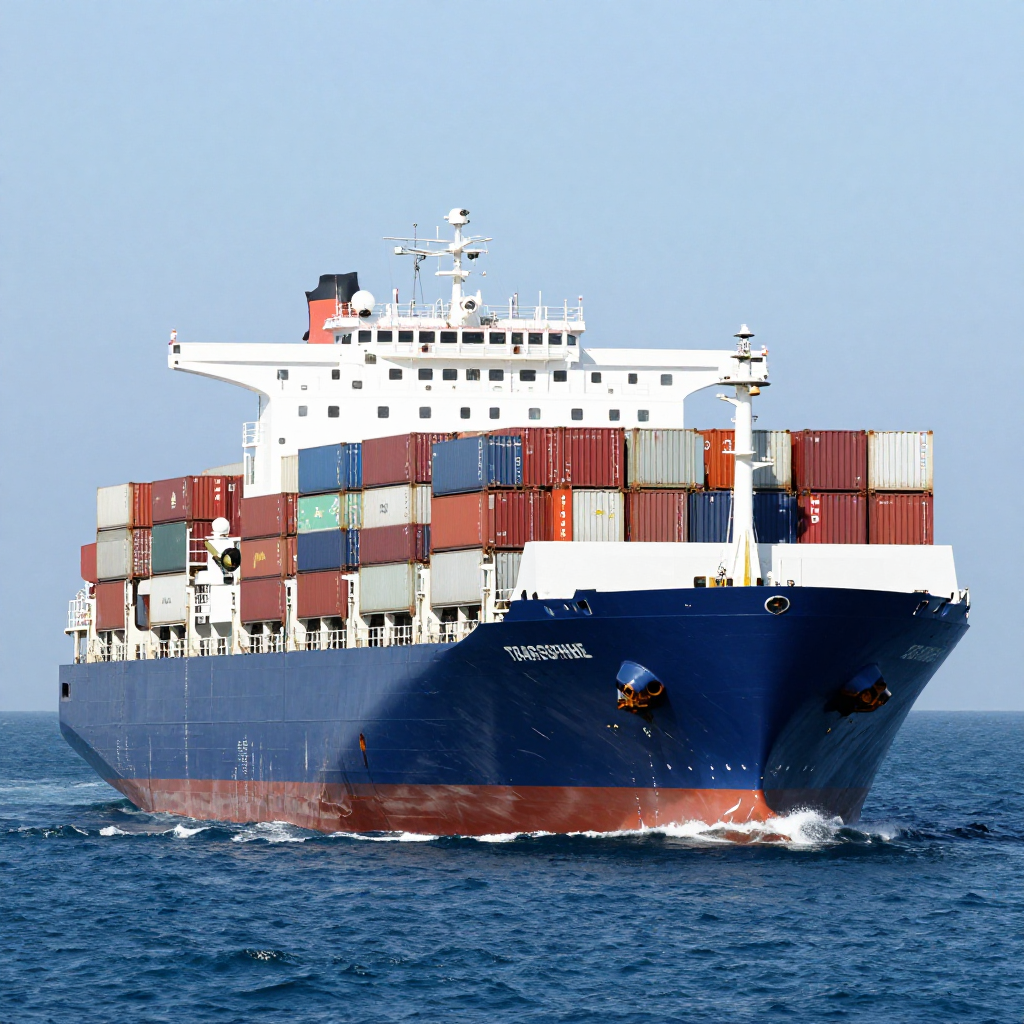
Maritime transport, which accounts for 90 per cent of international trade, is responsible for 2 to 3 per cent of global greenhouse gas (GHG) emissions. In April 2025, the International Maritime Organisation (IMO) adopted a landmark framework to reduce these emissions, but its formal adoption, originally scheduled for October 2025, has been postponed until 2026. What is the current situation? What are the challenges and the proposed solutions for decarbonising this vital sector?
Shipping: a giant with feet of clay
Shipping emits every year, nearly 1,000 million tonnes of CO₂, which is as much as global aviation. Its emissions, although receiving less media attention than those of air transport, are rising by an average of 2 per cent a year, driven by the growth in international trade. The sector remains heavily reliant on heavy fuel oil, one of the most polluting fuels, and 35 per cent of maritime transport is dedicated to… the transport of fossil fuels.
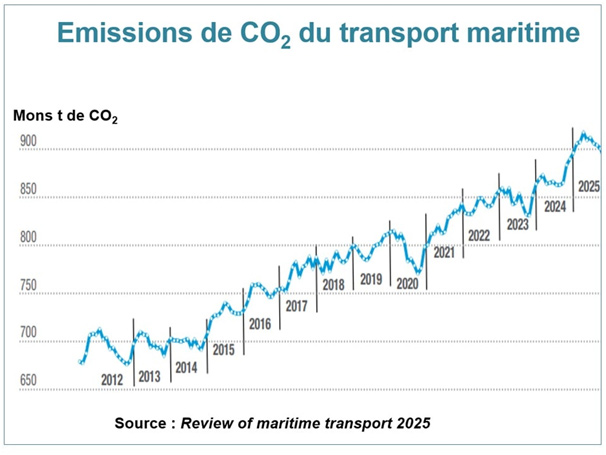
Unlike other sectors, emissions from the shipping industry are not included in national accounts, but are regulated at international level through the IMO. Since 2018, the organisation has gradually raised its targets: a 20–30 per cent reduction in emissions by 2030, 70–80 per cent by 2040, and carbon neutrality «around 2050’ ».
The IMO agreement in 2025: a step forward, but with delays and limitations
In April 2025, the IMO adopted a «net-zero emissions framework», including, for the first time, a global carbon pricing mechanism. The text, which was due to be formally adopted in October 2025, has now been postponed until 2026. This postponement reflects the difficulties in reaching a consensus amongst the 175 member states, particularly regarding the level of ambition and the implementation arrangements.
What solutions are there for decarbonising the sector?
The decarbonisation of maritime transport rests on three pillars: energy efficiency, alternative fuels and reducing demand.
a. Energy efficiency: quick but limited gains Optimising ship speed, improving hull design, installing wind-powered propulsion systems… These solutions, which are already well-established, enable immediate reductions in fuel consumption. However, they will not be enough to achieve carbon neutrality.
b. Alternative fuels: between promise and limitations
- Biofuels : Available in the short term, but their large-scale production poses a threat to farmland and forests.
- E-fuels (synthetic hydrogen, ammonia and methanol): Produced from renewable energy sources, these are key to deep decarbonisation, but their cost (up to 10 times that of fuel oil) and limited availability are holding back their adoption.
- LNG : Less polluting than heavy fuel oil, but still produces emissions and is set to be taxed from the 2030s onwards.
c. Reducing demand: an underestimated lever The global energy transition is expected to reduce the transport of fossil fuels, but the growth of e-commerce and international trade could offset this decline. Energy efficiency (slowing down ships, optimising routes) remains a key lever, but one that is difficult to enforce in a highly competitive sector.
Upcoming deadlines and challenges
The IMO framework, which is now due to be adopted in 2026, will come into force in 2027–2028. It is due to be reviewed every five years, with the possibility of raising the targets. The European Union, through the FuelEU Maritime Regulation and the inclusion of the sector in its Emissions Trading Scheme (ETS), is pushing for a faster transition, but international coordination remains complex.
Uncertainties remain: the level of incentives for green fuels, the exact carbon intensity of biofuels, and the ability of governments to finance the transition. Without massive investment and stronger political will, the IMO’s targets risk remaining out of reach.
The path forward is clear: by 2050, maritime transport must achieve carbon neutrality. This ambition is already driving innovation and creating new markets: green fuels, propulsion technologies, route optimisation, ship retrofitting… E-fuels, hydrogen and hybrid solutions offer growth prospects for manufacturers and investors.
It also holds the promise of modernisation for a sector that has always been able to adapt to industrial revolutions. Those players who anticipate these changes – by developing clean technologies, training their teams, or securing partnerships for the supply of sustainable fuels – will be the big winners of tomorrow.
 French
 English