
Improving trade with their regional neighbours: a major economic opportunity for the overseas territories. According to a study published on 23 September 2025 by IEDOM-IEOM, backed by the Banque de France, these regions could significantly boost their exports to and imports from neighbouring countries, bringing tangible benefits for purchasing power and local development. An analysis of the prospects ahead.
France’s overseas territories occupy a unique position in international trade. Whilst they are closely integrated into the French and European economies, they remain relatively isolated from their immediate regional environment. A recent study by IEDOM-IEOM, backed by the Banque de France, highlights the extent of the untapped commercial potential, in terms of both exports and imports, and the measures likely to strengthen the regional integration of the overseas territories.
Open economies… but with little integration into their regional environment
France’s overseas departments and territories share many characteristics with small island developing states (SIDS): small domestic markets, remoteness from major global economic centres, dependence on imports and high exposure to logistics costs. These structural constraints limit their ability to achieve economies of scale and to integrate fully into global value chains.
From a sectoral perspective, overseas exports are concentrated in a limited number of products. Natural resources dominate in certain territories (nickel in New Caledonia, gold in French Guiana), whilst agriculture and the agri-food sector play a central role in the French West Indies and Réunion (sugar, bananas, rum). Whilst this specialisation reflects comparative advantages, it also exposes these economies to greater dependence on a few markets and products.
Compared with other small island developing states, France’s overseas economies export relatively little in relation to their GDP, with the notable exception of New Caledonia. On the other hand, their level of imports is comparable to that of their island neighbours, reflecting a high degree of openness… primarily towards mainland France.
A heavy reliance on France, to the detriment of regional trade
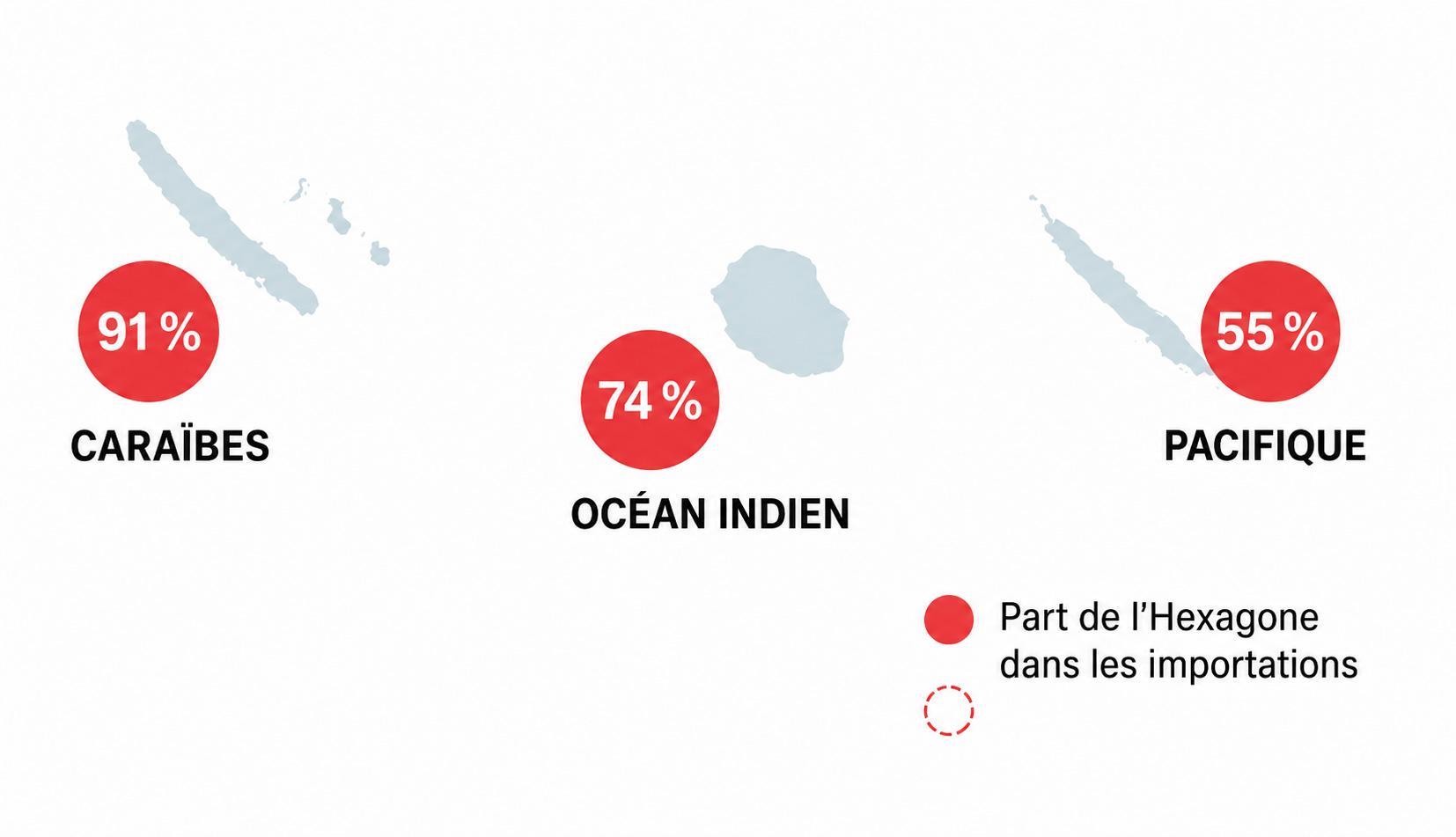
One of the key findings of the study is that a very marked economic dependence on France. Between 2013 and 2022, nearly 60 per cent of imports into Guadeloupe, Martinique and Réunion came from mainland France. As for exports, more than 80 per cent of trade from the French West Indies is directed towards France (the mainland and other overseas departments and regions), whilst neighbouring Caribbean countries trade mainly with North America.
This pattern is also evident, with some variations, in the other regions. In the Pacific, New Caledonia and French Polynesia export mainly to Asia, but have little intra-regional trade, unlike other SIDS in the region. In the Indian Ocean, Réunion remains heavily oriented towards Europe, whilst Mauritius has succeeded in developing more balanced trade relations with its regional partners.
Significant scope for growth, both in exports and imports
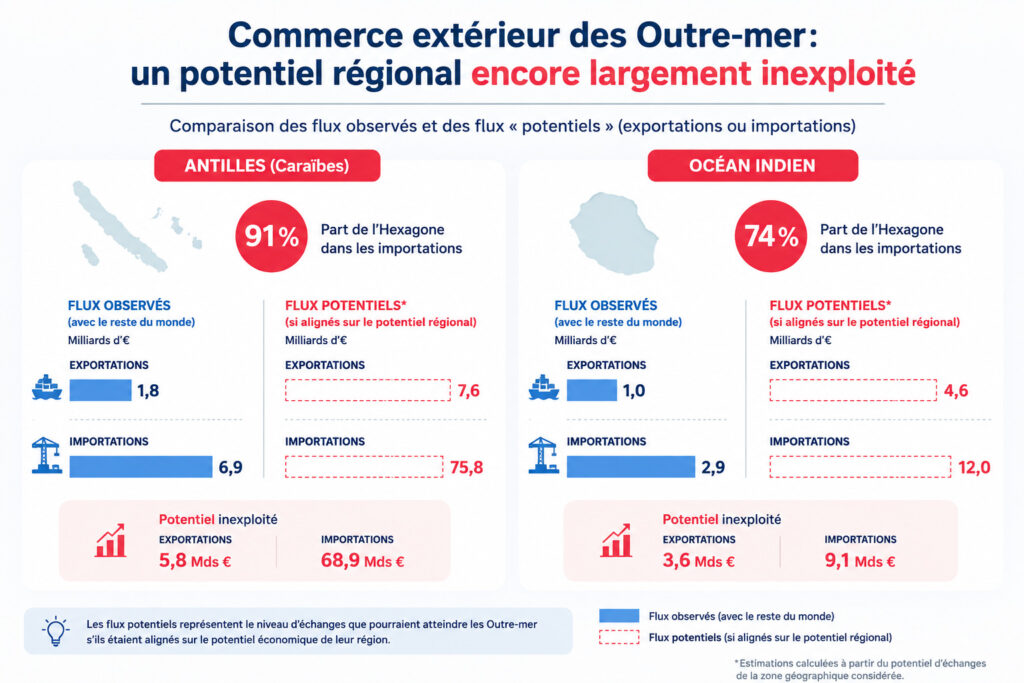
To assess the scope for manoeuvre, the authors draw on a gravity model, a leading reference tool in international economics, in order to estimate «theoretical» levels of trade, taking into account the size of the economies, distance and bilateral characteristics. The discrepancies between observed and estimated trade flows reveal significant untapped potential.
In the West Indies, the figures are particularly striking when compared with the US market. In 2021, exports from Martinique to the United States accounted for only 12 per cent of their estimated potential, and those in and around Guadeloupe 30 %. Given constraints comparable to those faced by their Caribbean neighbours, exports from Martinique could triple and those from Guadeloupe could double, with a particularly marked impact on the agri-food sectors.
When it comes to imports, the overseas territories could also make better use of their regional environment. In French Guiana, imports from Brazil are significantly lower than those from Suriname or Guyana, even though these countries are geographically close. In the timber and plant products sectors, greater regional integration would make it possible to increase import volumes and diversify supply sources.
In Réunion, imports of plant and agri-food products continue to be overwhelmingly directed towards mainland France, unlike Mauritius, which sources a large proportion of its supplies from southern Africa. According to estimates, Réunion could double its regional imports in certain sectors if it offered trading conditions similar to those of its neighbour, Mauritius.
Beyond customs duties: removing non-tariff barriers
Finally, the study highlights that free trade agreements alone are not sufficient to explain the low level of regional trade. In some cases, they have even led to trade diversion effects, to the benefit of distant markets. The main obstacles identified relate instead to non-tariff barriers : standards, languages, a lack of knowledge of neighbouring markets, a logistics system historically geared towards mainland France, and the insufficient organisation of regional supply chains.
For those involved in international trade, these findings open up concrete prospects. Better connecting the overseas territories to their regional markets, supporting the diversification of trading partners and adapting supply chains to local conditions could help to strengthen the economic resilience of the overseas territories, whilst also helping to tackle the high cost of living.
 French
 English